I found this on my way to work in the city center. It’s made of metal, all the parts are identical and can move, but the whole thing isn’t meant to come apart.
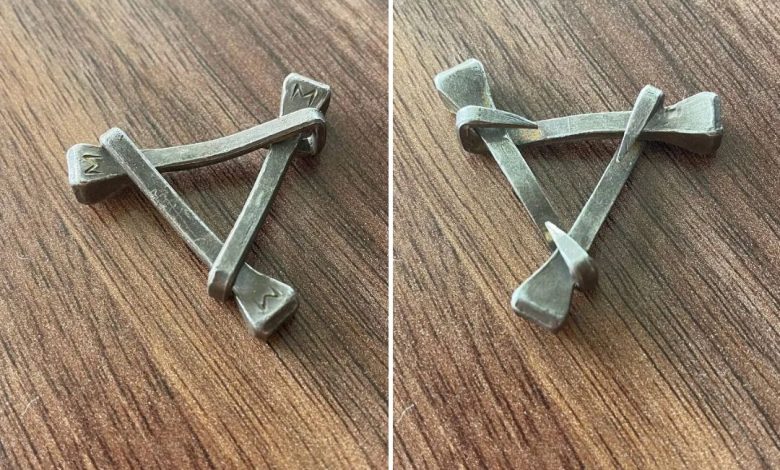
A small metal object found on a city-center sidewalk initially appeared to be some kind of mechanical puzzle. It consists of three identical metal pieces, each bent and interlocked with the others so that they can move but apparently cannot be separated.
The unusual object is most likely a handmade ornament made from three farrier’s nails, also known as horseshoe nails.
What Is It Called?
There does not appear to be one official name for this particular design. It may be described as:
- An interlocking horseshoe-nail ornament
- Farrier’s-nail folk art
- A horseshoe-nail charm or novelty puzzle
The individual pieces were originally manufactured as nails for attaching metal horseshoes to horses’ hooves. Someone later bent and linked three of them together to create a decorative object.
Although it resembles a puzzle, it may not have a conventional “solution.” The pieces could have been permanently interlocked during the bending process. Therefore, its most likely purpose is decoration, jewelry, a good-luck charm or simply a conversation piece, rather than practical use.
What Do the Three “M” Marks Mean?
The engraved letters provide the strongest clue to the object’s identity.
The “M” is probably the trademark of Mustad, a major manufacturer of horseshoe nails and other hoof-care products. Mustad’s technical literature states that its “M” is stamped on the inside of a nail’s head. The mark is placed on the same side as the nail’s bevel, helping a farrier identify the correct orientation while driving it.
Mustad was founded in Gjøvik, Norway, in 1832. During the nineteenth century, the company developed machinery for the automatic production of horseshoe nails and became a major international supplier of metal products.
The marks therefore do not represent a secret message or decorative symbol. They are most likely manufacturer and orientation markings left on the original nails.
What Were the Nails Originally Used For?
A farrier is a trained specialist who trims and cares for horses’ hooves and fits horseshoes when needed.
Horseshoe nails are specially shaped so that a farrier can drive them through the tough outer wall of the hoof while avoiding the sensitive tissue inside. The protruding end is then cut and bent against the hoof, helping hold the horseshoe securely in place.
Unlike ordinary construction nails, horseshoe nails normally have:
- A wide, distinctive head
- A long, narrow shank
- A carefully shaped point and bevel
- Enough flexibility to bend without breaking
Those characteristics are visible in the three pieces used to make this object.
When Were Horseshoe Nails Invented?
The precise origin of nailed horseshoes remains uncertain. Archaeologists have found evidence associated with nailed horseshoes from approximately the fifth century A.D., but clear written references did not become common until around A.D. 900–1000. By the Middle Ages, nailed iron horseshoes were widely used across Europe.
However, that does not mean the object in the photographs is medieval. Its relatively uniform nails and visible Mustad markings indicate that it was almost certainly made from modern, factory-produced horseshoe nails.
The exact date when someone assembled the three nails cannot be determined from photographs alone. It is most reasonably described as a modern handmade piece inspired by blacksmithing and farrier traditions.
Final Identification
The object is made from three Mustad farrier’s nails that have been bent and permanently interlocked. The nails were originally intended to secure horseshoes, but in this form they serve as folk art, an ornament, a charm or a puzzle-like novelty.
It is not a specialized tool, and it is unlikely to be an ancient artifact. Its appeal comes from transforming ordinary equipment from the centuries-old craft of horseshoeing into a small and mysterious piece of metal art.